
Soft Washing vs Pressure Washing
One removes growth with force, the other kills it with chemistry. The surface decides which.
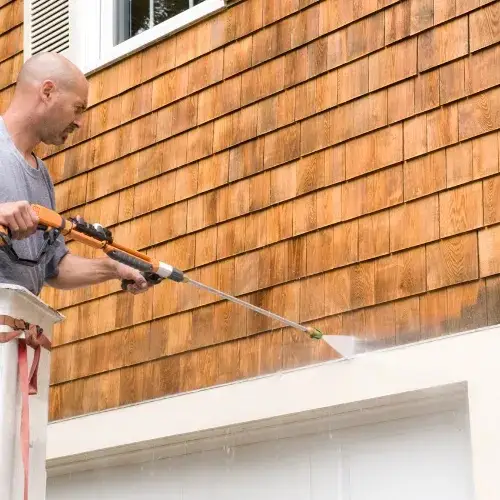
Two different jobs with similar names
Pressure washing does the work with force. Water at high pressure physically knocks growth and grime off a surface, and on hard materials that is exactly right.
Soft washing does the work with chemistry. The solution goes on at low pressure, sits for a while, kills the organism, and then gets rinsed away. The pressure at the surface is closer to a garden hose than a lance, because pressure is not what is doing the cleaning. Dwell time is.
Neither is better. They are answers to different questions, and picking the wrong one is where exterior cleaning goes wrong.
| Pressure washing | Soft washing | |
|---|---|---|
| What actually does the cleaning | Mechanical force from the water | Chemistry, given time to act |
| Pressure at the surface | High, through a lance or a turbo nozzle | Closer to a garden hose |
| What decides the result | Nozzle choice, distance and technique | Dwell time and the strength of the mix |
| How it feels to watch | Fast, the surface changes in front of you | Slow, most of it is waiting |
| What it leaves behind | The visible layer gone, the organism often still in the pores | The organism killed, so regrowth has to start from nothing |
| Right for | Hard, dense, unpainted surfaces | Anything living, and anything painted, glazed or brittle |
| What goes wrong when it is misapplied | Water driven under laps and into sheet joins, stripped glaze, furred timber, blown out putty | Little risk to the surface, but nearby planting has to be wet down and covered first |
Why chemistry beats force on living growth
Mould, algae and lichen are organisms, not dirt. Blast a green wall with high pressure and it will look clean by the afternoon, because you have removed the visible layer. What stays behind is everything sitting in the pores of the surface, and the wall re-greens noticeably faster than it did the first time.
A soft wash kills the growth outright, so what regrows has to arrive from scratch rather than continue from a head start. The practical difference in the tropics is months. The detail that makes it work on a vertical surface is a surfactant in the mix, which thickens the solution so it clings to a wall long enough to act. Without one it runs to the ground in seconds and does nothing.
Which surface gets which
The short version is that hard, dense and unpainted takes pressure, and everything else does not. The longer version is worth having surface by surface, because most Cairns houses are a mix.
| Surface | Method | Why |
|---|---|---|
| Concrete driveway, path, carpark deck | High pressure | Hard and dense, comes up beautifully under direct pressure and moves fast |
| Block retaining wall, unpainted masonry | High pressure | Same reason, provided the mortar joints are sound |
| Paved pool surround, pavers generally | Controlled pressure | Works well, but the joints are sand and heavy handling blows them out, so they get topped up afterwards |
| Tiled roof | Soft wash | Direct pressure strips the surface glaze and forces water back under the laps |
| Metal and Colorbond roof | Soft wash | Growth needs killing rather than blasting, and pressure at the laps and fixings buys you leaks |
| Painted render | Soft wash | Pressure lifts the coating at the edges and holds water in the texture that is already the problem |
| Fibro and fibre cement sheeting | Soft wash | Pressure drives water into the sheet joins and lifts paint at the edges |
| Weatherboard and painted Queenslander timber | Soft wash | Pressure furs the timber and blows out putty and glazing |
| Colorbond fencing | Soft wash | Thin sheet, painted finish, nothing to gain from force |
| Timber deck | Either, with care | Gentle pressure with a wide fan and attention to grain direction works, but a chemical clean and a light rinse usually finishes more evenly with no lap marks |
Timber decks are the genuine in between case, and they are the one worth talking through rather than assuming.
The honest test
If someone quotes to high pressure clean your whole house without asking what the walls are made of, be careful. In Cairns the same street can hold a rendered block home, a fibro cottage and a high set timber Queenslander, and all three want different handling. Most jobs end up being a mix: soft washing on the roof and walls, direct pressure on the driveway and paths at the end.
Call 07 4028 4268 and describe the surfaces, and you will get told which of the two your place needs, including where one is not worth doing at all.
-
The Benefits of Regular Pressure Washing
Washing on a schedule is cheaper than waiting until the growth is obvious, and here is why.
-
What Drives the Cost of Pressure Washing in Cairns
The five things that decide what a wash costs, and why area is not one of them.
-
Signs Your Roof Needs Cleaning
How to read a Cairns roof from the ground, and when washing it is no longer the right call.
Get a free quote
No obligation, and a straight answer about whether the job is worth doing.
- Hours
- Weekdays 8 to 5
- Covers
- Cairns and the northern beaches corridor
- Quotes
- Free, from photos or on site
- Photos beat descriptions. Two shots of the dirty area and we can quote most jobs same day.
- Roof, driveway and house washing get different pressures and different chemistry, and the quote says which.
- One figure for the whole job. Nothing gets added once we are up the ladder.